Grandma Magic Podcast Episode 32: Sue Boardman, Fiercely Compassionate Rebel Grandmother
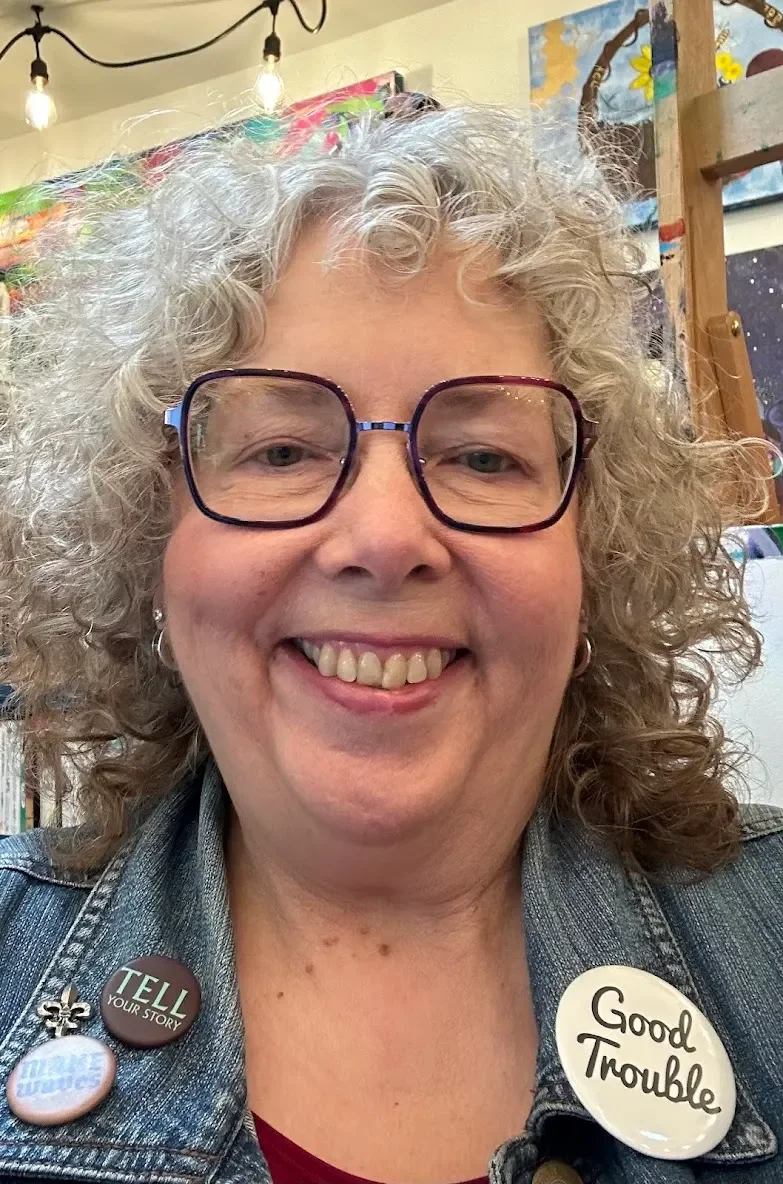
Sue Boardman proudly calls herself a “fiercely compassionate rebel grandmother-for-rent” — a title that perfectly captures her fierce devotion to healing, growth, and self-discovery. Through her many roles as a nurse, pastor, artist, writer, and lifelong learner, Sue has spent her life guiding individuals and communities toward transformation. In this conversation, she shares how a single moment — encountering the phrase “fierce compassion” — shifted her internal filter and set her on a journey into intentional creativity, oracle cards, and sacred storytelling. As a grandmother and children’s book author, Sue is reimagining creation as a place where every child feels seen and included. With radiant artwork, inclusive language, and even a cover that feels good to the touch, her book offers a tactile and heart-centered invitation into an expansive, welcoming world. Sue reminds us that transformation doesn’t require having all the answers — it begins with the willingness to do the next right thing. And sometimes, that next right thing is telling a new story. One that ripples outward.
Transcript
Lynsey Farrell (Host): Welcome To Grandma Magic, a podcast from the Grandmother Collective. We are a nonprofit organization that supports and advocates for a world where a grandmother’s power is seen, cultivated, and activated for positive change.
The Grandma Magic podcast is an opportunity to learn more about the unique roles that grandmothers, aunties, and other older women around the world can play in advancing positive social development. By talking to and learning from grandmother change makers. We hope this series inspires you, brings you joy and helps you recognize the enduring magic and wisdom that comes from grandmothers everywhere.
My name is Lynsey Farrell, and I’m your host today. We are honored to welcome Sue Boardman, a perpetual learner whose path has woven together roles as a registered nurse, master of divinity, doctor of ministry, author, artist, activist, and intentional creativity teacher. With a background in pastoral counseling, coaching, and creative expression, Sue has spent decades guiding individuals and communities towards healing, growth, and self-discovery.
She calls herself the fiercely compassionate rebel grandmother for rent, dedicated to helping people live their deepest dreams. Sue’s journey began as a single mother determined to shape a meaningful life for herself and others. She spent 25 years serving the Presbyterian Church USA as a pastor and pastoral counselor while also writing for Monday Morning Magazine and the Presbyterian News Service.
Over the years, she has integrated a diverse set of skills from hypnotherapy and neuro linguistic programming to the Developing Capable People program, which she has led for more than 30 years. As life led her to embrace change, she found new creative avenues in writing and painting, authoring several number one best selling books including “Grandmothers are in Charge of Hope” and “We Gather Together”. Her work continues to uplift and inspire, particularly through her latest project, a children’s book that re-imagines an ancient story for a new generation. Thank you for joining me, Sue.
Sue Boardman: Thank you so much for inviting me.
Lynsey Farrell (Host): I can’t actually think of why we didn’t get you earlier. I mean, grandmothers are in charge of hope. Absolutely.
Sue Boardman: Totally. And, at this moment in time, somebody needs to be.
Lynsey Farrell (Host): Yes, in charge of hope, in charge of leadership, in charge of building community, all the things that we really recognize are incredibly powerful about older women everywhere. Okay. So, I didn’t put this in our sort of pre-notes. But I really love asking people, if they’re going to leave something for their next generation, you’re a grandmother. What is it that you want to make sure that you really pass down?
Sue Boardman: Wow, that’s a big question. And I’m going to back up to before I was a grandmother for the answer to this. When I was four months pregnant, I left an abusive marriage. And trust me when I tell you I had a whole bunch of things I needed to learn quick. One of the best of those things came from a guy named Steve Glenn, who wrote a book called Raising Self-Reliant Children. And I will never forget sitting on a gym floor with about 3,000 young adults learning Steve’s stuff. And Steve said that if a teenage child has five adults who will listen to them, take them seriously, and not shame or blame them for their questions, that child is practically immune from ever attempting suicide. And that’s where it all started for me.
Lynsey Farrell (Host): It’s so powerful. So you basically use that initial, I’m rough, I’m navigating trauma, I’m navigating new motherhood, which is in and of itself, like kind of a trauma as we sort of shift our social role and take on this new identity. And amidst all of that, you said, I’m going to be one of those adults for young people.
Sue Boardman: I did. And one of the first things I learned about that was that if I was going to do that for other people, I needed to be able to do that for me. I need to be one of those five people for me. That’s kind of been a cornerstone of not only my own learning, but my teaching.
Lynsey Farrell (Host): And has been informing what you’ve done. So you are, as many of the women that I interview, kind of a mosaic. You’ve built yourself a life that clearly is one of purpose, and focused on personal and community connection — along this journey of nursing, ministry, creativity, contemplation. What has been connecting those things for you and like can you walk us through some of the decision making that you had.
Sue Boardman: Let me start by telling you how I got into nursing. Into it was because it was handy and quick and I could feed my kid. Out of it was because I got tired of getting told I didn’t get paid to think. And yeah, this was in the dark ages. Back in the day when all the docs were men and all the nurses were girls, and yeah. I got tired of getting told I didn’t get paid to think. And one day the little lightbulb went on above my head and I said, the next right thing has got to be soon. And I went back to school, to finish my bachelor’s degree, and one of the first things I learned at Eckerd College in Florida, in the first course I took, was an old Quaker saying, that in order to learn, we must be willing to be changed.
And after that I wound up at seminary, much to my huge amazement, and it’s kept evolving from there in the sense of, me being more me and me learning more ways to help other people be more who they are. And then one day my kid called and told me I was going to be a grandmother. And everything got different, bigger.
Lynsey Farrell (Host): Yeah, I hear that a lot. Explain that. What does that mean that it got bigger?
Sue Boardman: Well, I had been doing a workshop at a local church on a Sunday afternoon with five women friends of mine. We were actually making quilts for small children that were in difficult situations. And we came home, we’re sitting around, we’re singing “Peter, Paul and Mary” on the living room floor and all that sort of jazz and the phone rang and my son was calling from Scotland. And we, you know, how are you doing? For a little bit and then Dave said, “Mama, you’re going to be a grandmother.” And I didn’t say anything at all.
Lynsey Farrell (Host): No, you had no expectation of that?
Sue Boardman: Oh, no, no, this was a total surprise for all of us. Okay, and my whole world got a whole lot bigger and also closer in that moment and, everything’s been different since then. It’s a whole new perspective for me and things that I didn’t used to think were important got a whole lot more important. One of the things that the kids needed was some healthy baby things that weren’t available to them in Scotland. So I was in charge of taking those, but we had a long distance baby shower and my mom was there and my sister and a bunch of old friends and stuff. And what Kelly, my daughter-in-law asked for was, baby books and music because, I mean, you couldn’t take a crib on the plane to Scotland. So, we did that and just even the process of picking out baby books, and a James Taylor lullaby CD, the way I made the choices, was totally different.
Lynsey Farrell (Host): Than when you were a mother?
Sue Boardman: I didn’t have time to make choices when Dave was a baby. I mean realistically, I obviously I did, but I had learned a lot more in between there. And making choices for this little person that nobody had ever met yet. And thinking about what I hoped she would soak up when she listened to those stories in the music and, it was a really, really different perspective.
Lynsey Farrell (Host): Do you feel like it’s like a different responsibility too?
Sue Boardman: Yes. And, for me at least, it was in the sense that I could focus more on making those choices because I wasn’t working quite so hard to survive as I had been, you know, when my son was born.
Lynsey Farrell (Host): So at that personal level, you’ve felt the change, you felt the transition, you felt the like, whatever it is that grandmotherhood brings. You’re not the first to have shared this with me. But did anything shift in what you were doing for your career or how you were spending your days?
Sue Boardman: I was doing mostly pastoral counseling at that point in time. You know, a couple of rocking chairs and cups of tea and, sorting things out. And, I kept doing that.
Lynsey Farrell (Host): It sounds pretty grandmotherly, actually.
Sue Boardman: Imagine that. I might have been in training.
Lynsey Farrell (Host): You were, you were already in training. Yeah.
Sue Boardman: Yeah, but, it was along about that same point in time that, there’s a guy named Fred Buechner who was an author and theologian and, really cool sort of guy who’s, gone on at this point in time. But Fred said that the place where we are called is where our deepest joy and the world’s deep longing meet. And I think I knew that before I found out I was going to be a grandmother, but I think I understood it (after I got that huge news). And owned it much more deeply at that point. And most of what I have done since then has been that.
Lynsey Farrell (Host): Looking for that intersection of what makes you joyful and what are the kind of gaps around you.
Sue Boardman: Not only looking for it, but, helping myself and lots of other people to claim it. And then to figure out the path from where we are now to where that place is. And that’s a great deal of the work that I do.
Lynsey Farrell (Host): Can you give like an example of what, taking someone on that journey looks like, or what that might have looked like for you?
Sue Boardman: I think the first big step is claiming some provisional notion of where that place might be. And of course when you factor in the world’s deep longing it gets complicated through time. So here you are, wherever it is that we’re sitting today. And there’s that place over there that you really feel called to be.
Because not only does it matter to you, but it matters to the world and in my case, the world that your grandkids are growing up in, which is the big one for me. How do you get from here to there? In the land of intentional creativity where I, learned to paint and so forth, we have a metaphor called medicine basket. And everybody has their imaginary medicine basket. And as you go along the path, you learn new tools to put in your medicine basket. And, I have lots of those, my medicine basket is approximately the size of a semi-truck these days.
Lynsey Farrell (Host): Hey, that’s just that grandma wisdom that you’ve been collecting for decades.
Sue Boardman: Some of those things are, artistic expression, storytelling, my two grandmothers when I was growing up, were wonderful, delightful human beings who loved me and my sister to death. My mother’s mother was the food and games grandma. She was tons of fun. And the big joke in the family was, she taught us to play card games and kept our pennies when we lost.
Lynsey Farrell (Host): She was teaching you a lesson. Yeah. Yeah. That’s smart.
Sue Boardman: My dad’s mom for me was the story grandma. And, she’s the one I tend to call on most often these days. So stories are a big medicine in my basket. I also learned a lot of stuff like neuro linguistic programming and Ericksonian hypnosis and blah, blah, yada, yada. And the bottom line on all of that is that we all experience the world differently, though nobody told us that in biology class, at least not back in the day. And when we can help people to understand that, and claim it, and put that as medicine in their basket, then there aren’t so many people running around all the time feeling like they’re doing it wrong.
Lynsey Farrell (Host): Yeah.
Sue Boardman: Which means that then you actually get stuff done.
Lynsey Farrell (Host): Because you’re not putting barriers up because you yeah, because you’re feeling like why is everybody else able to do it this way, and I can’t seem to put my shoes on in the right order or whatever it is.
Sue Boardman: One of the big examples for me, is that I am not inherently a visual person. There are no pictures in there, or there, there didn’t used to be any pictures in there. And when I dream, it’s more like hearing a story than it is watching a movie, and has been all my life. The deeper I get into the image-making, the more access I get to images in my head. And people notice different patterns. There’s the visual stuff and the auditory digital stuff and the kinesthetic, which is feelings and movement. And everybody has different ways they process things. And if only you can help people to claim that. The world gets much, much bigger.
Lynsey Farrell (Host): Does it also get more empathetic?
Sue Boardman: Yes, absolutely. And I’ve gotten to the point these days where, I’ve been painting a while now. There’s a lot of paintings at my house and there are specific ones that hang on the wall in the bedroom, because they talk to me in my sleep. This is true. At least it’s my true experience.
And when I wake up in the morning, very often there’s an answer to whatever it is I was trying to solve when I went to bed or, a new idea about, oh, how to move forward in the book I’m writing or, whatever. And that was all very much a part of writing that first children’s book. I had no idea I could do that and paint all the illustrations and, no clue I could, that was possible for me.
Lynsey Farrell (Host): And you’re saying because you were able to paint and then surround yourself with it that you were able to unlock something in yourself.
Sue Boardman: I’ve been able to get comfortable with all of my processing patterns and access the one I need in the moment. Then, yes, many more things are possible for me. And this is true for everybody who will take the chance on learning that kind of thought process.
Lynsey Farrell (Host): So is this, what you’re describing, what I’ve read from you as metacognitive drawing?
Sue Boardman: It is totally related to that.
Lynsey Farrell (Host): Okay. So what is that?
Sue Boardman: Metacognitive drawing is basically thinking about thinking while moving a pen on a piece of paper. Or a marker. So that’s all three primary processing patterns working at once. Because you’re watching the pen move and you’re thinking the words and you’re feeling the movement. And I know this sounds bizarre if you haven’t done it yet. But, if you’re thinking about a particular question and you’re just moving the pen and watching it very, very often a new “aha” appears. Then you have to figure out what to do with it. It’s not like all the problems are solved in the moment. But, one of my clients, we were doing this one day, and she said to me that the metacognitive thing helps my brain stop being obsessive compulsive about the problem or emotion or whatever. And allows me to see myself and my issues from all the angles.
Lynsey Farrell (Host): It helps her get over herself.
Sue Boardman: Yeah! A lot of us learned to just eat a couple dozen chocolate chip cookies while we were, you know, wrapped around the axle about not knowing what to do next. Metacognitive drawing has some advantages over that. I’m not dissing chocolate chip cookies, but, um.
Lynsey Farrell (Host): We don’t need as many as we would like to eat in moments of stress.
Sue Boardman: Well, no, and, and there are other ways to get there, that can be really helpful. And then the “aha” moment when it comes is both intensely liberating and also extremely encouraging. Because then, if you got the “aha” for this step on the path, that makes it entirely more possible that there’ll be an aha for the next step too.
And you’re not actually out there on the road all by yourself.
Lynsey Farrell (Host): I think I get it. I think it’s basically saying that it’s setting you up to feel confident that, you’re going to get to an answer or that a solution will emerge. Sometimes people really want like a template or a framework, right? They talk about frameworks. And so that sort of like helps them feel like there’s like a cheat.
Sue Boardman: Well, and there kind of is. I’m getting ready to teach a class that is nicknamed “filters”. It’s a model of human perception that is kind of like, a cheat, but it’s more like a map that you set out and, you get so far down the road and then you get a new question. And then you adjust a little bit for the new question and you keep going. But, you’ve learned enough to know that that’s normal and hang with it. Which is the part that’s really exciting for me.
Lynsey Farrell (Host): So would you say that you’re helping people navigate change?
Sue Boardman: Yes. And I’m also helping people navigate having and claiming desires in the middle of chaotic change.
Lynsey Farrell (Host): I mean, it’s so relevant right now. I think a lot of people, it sort of feels to me, that I’m going to bring it back to your medicine kit or your medicine box, that a lot of people don’t have inside their medicine kit or toolbox or whatever, ways to explain uncertainty. Ways to filter through, misinformation, like somewhere along the way, I don’t know what’s caused it, other than like claiming social media or some, you know, or capitalism or something like, I could come up with some like meta narratives. But it does seem to be that, really seem to be having an epidemic of people lacking those skills.
Sue Boardman: Can I give you an example? One of the things in the filters model is the beliefs that we carry around, many of which are non-conscious. And Carl Jung would tell us that the first belief that any of us develop is that in order to survive, we have to keep the tall people happy. You know, and I mean, think about an infant. In order to survive, you got to keep the tall people happy. So we’re all carting that around, and it’s not conscious for most of us until it is. Hallelujah.
Lynsey Farrell (Host): What part’s the hallelujah that it’s unconscious or that it becomes conscious? Oh, okay.
Sue Boardman: Yeah. But a lot of those beliefs start out with we always or we never. And one of the examples in my family, the cooking and game grandma, you had three kinds of cookies for Christmas every year or the world would end.
Lynsey Farrell (Host): Yeah, oh no, I got grandma like that.
Sue Boardman: Yeah, the little cookie press butter cookies that I absolutely loved, something called pecan crunch cookies, which were really good, but harder to make. And then, fruitcake cookies.
Lynsey Farrell (Host): With like the candied cherries on it. Oh.
Sue Boardman: Yeah, you had to have those.
Lynsey Farrell (Host): Even if no one ate them.
Sue Boardman: Exactly, and my mother was a huge believer in you had to do it the way grandma did it. That’s how you survived. So, when I was about 10 we moved to Florida. And it’s a lot hotter in Florida at Christmas time than it is in the Midwest. So mom made fruitcake cookies, cause you gotta, and, nobody ate them. And about three months later, she found them like all moldy in the cupboard, which was gross. And it still took her three more years to quit making fruitcake cookies.
Lynsey Farrell (Host): Right.
Sue Boardman: I mean, they were expensive, they were a pain in the butt, and nobody wanted to eat them. But we always made fruitcake cookies. And that’s how we knew we were going to survive, cause we had survived that far. I mean you and I are sitting here talking about cookies. Editing beliefs is a whole lot of how we get from where we are to that place where we feel called to be.
Lynsey Farrell (Host): I think about my own upbringing where I had lots of never’s and always’, but then I left and I’ve spent 25, almost 30 years apart from my people who taught me the always and the never and they’re over here now and I went on a journey, and like little pieces of me just continued to shift and I know I’m not the only one right? We aren’t living in these units where we’re always and never anymore, diversity and experience and other things.
Sue Boardman: And what if- we’re going to imagine for a moment, some of those people from back in the always and never days, could come and, gather around a holiday table and celebrate and enjoy each other and accept each other with their variations on always and never. And we didn’t have to stay gone for 20 or 30 years. But what if there was a third choice, which is, here’s what I believe, and, here’s where it works, and other places for a couple days it doesn’t work so well, but, it’s like there’s always, there’s never, and there’s sometimes, which to me at least is better than just always and never.
Lynsey Farrell (Host): Or both and. I see some people playing with this both and idea. How do we really integrate and, blow up the binaries that we’ve built up. So you do this at an individual level with folks. How does sharing this knowledge, getting more people to experience, recognizing and understanding perception, how do we do that at scale?
Sue Boardman: Well, Zoom is very helpful.
Lynsey Farrell (Host): Great! Wonderful times we’re living in, right?
Sue Boardman: Yeah. I actually have a six week long course coming up shortly. First time within that particular community. And we’re gonna get on Zoom and learn the things, and I’ve done this before, and the cool thing is, is you paint the whole map as underlayers of a painting, and then the top layers, that people would see when they saw it hanging on your wall, is filled with symbols of this place where you long to be.
Lynsey Farrell (Host): And that the world is longing for? We’re going back to that thing?
Sue Boardman: Yes, and so that’s one answer, you know, you get people in a room and you teach a class. The other one is, I know this is gonna freak you out, but you write a book.
Lynsey Farrell (Host): It doesn’t freak me out.
Sue Boardman: I’m teasing.
Lynsey Farrell (Host): Do, you know how many people I’ve interviewed that have written a book? It’s making me seem like very possible to write a book. I should write a book.
Sue Boardman: You should. I have, it’s big fun. And I’m actually writing the book that goes with all this “filtery” kind of stuff and all the important things I’ve learned and, can I tell you the title? The Art of Overcoming Obstacles.
Lynsey Farrell (Host): Very important today. That’s literally what I was just saying, is like we are with a lot of humans who sort of seem to shut down when like something changes in their lives, they’ve, they’ve lost the ability to respond.
Sue Boardman: I mean, if your always and your nevers don’t get you where you want to be, you gotta put something else in the medicine basket.
Lynsey Farrell (Host): And you’ve said all of this without mentioning a political figure. It’s just reality for all of us that this is important.
Sue Boardman: Well, yes, and the fact that I, used to be a Sunday morning preacher has given me practice at reframing.
Lynsey Farrell (Host): Yeah, so are you done with being a minister? Is that work done?
Sue Boardman: Oh no. I had knee surgery six times in nine years. It’s way too many times to be able to show up every Sunday morning and, stand up and have something to say. And so I kind of shifted, from being the preaching person, to being more the pastoral/counselor person. And it’s a better fit for my particular path. And given the political context I hadn’t mentioned, it’s probably a better idea for me at the moment and that’s okay.
Lynsey Farrell (Host): There’s so many ways to make impact in the world.
Sue Boardman: Yeah, and one of those ways is to be with somebody in something that matters deeply to them in a context where they can actually ask questions. And stop and think about new things. And, you don’t have to be done because we have to beat the Episcopalians to the Yacht Club for lunch.
Lynsey Farrell (Host): Is that what’s happening?
Sue Boardman: It used to. It used to. I was part of a church in Florida and, they had church at 10.45 on Sunday morning, which I thought was very bizarre, and I asked the pastor, what’s up with this and this is on a lake in Florida and there were two big churches on this lake and a yacht club and it’s like, well, we have to beat the Episcopalians to the yacht club.
Lynsey Farrell (Host): So we end at 11.45 and they end at 12.00 or something?
Sue Boardman: And, that was one of those half fun, full serious, kind of things. Yes. But it’s easier to just say, you know, here’s my calendar, stick your name on there and we’ll do a thing.
Lynsey Farrell (Host): And I think probably opens you up to probably more unexpected connections.
Sue Boardman: Yes. I will say though that I’m in conversation about teaching some of this stuff. If I had a decent shoulder, I could throw a rock from where I’m sitting and hit the seminary I graduated from. I mean, it’s like two miles down the road. And we are in conversation about doing some of this work there.
Lynsey Farrell (Host): Oh, good. Yeah. University or educational space. That’s amazing. Okay. So, you know, this thread that we’ve kind of been weaving, across this journey you’ve been on and this work you’ve been doing, is rooted in what you’ve described as fierce compassion. What does this mean? Do people cultivate this?
Sue Boardman: Can I tell you how I first learned the term?
Lynsey Farrell (Host): Sure.
Sue Boardman: When I was writing my first book, I was actually doing some work with the author and artist Sark. And so Susan and I were in a, just the two of us, Zoom meeting one day. And she said, will you play a game with me? It’s like, sure, and she busted out her deck of Mother Mary Oracle cards. Trust me when I tell you we did not cover oracle cards in seminary. Oh, not so much on the Mother Mary thing either. Anyway, so.
Lynsey Farrell (Host): Not at your seminary,
Sue Boardman: Yeah, exactly where I was. So, Susan’s out there in Portland or wherever and she’s doing the thing, you know, passing the cards through her hands. And she said, just tell me when to stop. You’ll know. And so it’s like, sure. So she did the thing and I said, stop. And she pulled out this card, it was number six, Our Lady of Dark Mysteries. And Susan was reading this to me, all the various kinds of this. And in there was the phrase, Fierce Compassion. And it’s like, game changer!
Lynsey Farrell (Host): Was it explained on the card or did you have to kind of define your own, define it, for yourself?
Sue Boardman: It said more about it, but compassion always sounds like kind of one of those, you know, smile and pat people on the head and say, oh, you know, I so hope it gets better. But when you add in that notion of fierce, like, I’m gonna help you fight for what you need. I’m gonna get really brave for my introverted self and speak out. About some of this stuff. The whole notion that, I mean, compassion isn’t just everybody sitting around holding hands. Though, that’s fine, that’s good, but it’s also action and change.
Lynsey Farrell (Host): I was just going to say it was active. Yeah. That’s what I’ve always had this problem of sympathy and empathy, right? Sympathy is just, it’s like a nothing it’s just like feeling sorry for people. That’s useless. But empathy is active. It’s like making yourself sort of feel uncomfortable in order to support someone else.
Sue Boardman: Yes. And then I would say that fierce compassion is the next thing down the road from empathy.
Lynsey Farrell (Host): It’s the next step.
Sue Boardman: And as it happened, Shiloh Sophia McCloud, who is the mama-bear in the land of intentional creativity, did the illustrations for the Mother Mary Oracle Cards. And so from Susan introducing me to the cards, I ended up meeting Shiloh, and I ended up painting, and so on and so forth.
And, that moment, literally, was the beginning of my having access to all of this stuff that’s actually useful.
Lynsey Farrell (Host): Because you took that one piece and it spoke to you in such a way.
Sue Boardman: It changed a filter.
Lynsey Farrell (Host): Yeah changed the filter.
Sue Boardman: It changed a filter for me.
Lynsey Farrell (Host): So Sue, before we leave, do you want to share a little bit about how all of this journey led you to this children’s book, and you’re not done, obviously, you’re going to continue to write forever. That’s also your medicine in your medicine kit. But, you kind of talked about like, being able to see differently in order to make a children’s book. But, do you want to share a little bit more about the book and what your plans are for it.
Sue Boardman: You know, there’s a lot of stuff going on in our world these days and in the news around us about who’s doing it right and who’s not, and who counts and who doesn’t, and whose stories are true and whose aren’t, and the book is literally a creation poem. I wanted a story for small children that they could feel included in a larger spiritual tradition than perhaps some of the ones they might have encountered, in this world. And, James Weldon Johnson was an African American poet, back in Reconstruction times, right after the Civil War. And he, wrote, the original version of this poem. As it happened, it just hit the public domain, when I was looking for a book to write. But what I did was I took very carefully the language and the illustrations in this book to try to make it so that, any child who wanted to be included in that story could be. It’s very definitely a read aloud book. And, the divine creator in that book is both masculine and feminine. And the human-ish images in there, some of them have like blue faces. And I just did the very best I know to make that book a place where every child could feel welcome.
Lynsey Farrell (Host): That’s, totally fits the trajectory of this life that you’ve led and, reminds me you know, when you were sharing about having to pick out stories for the children that were to be your grandchildren. You did know that too often, actually, maybe our stories are creating nevers and, have tos, and you were trying to create something different?
Sue Boardman: Yeah, something much bigger that people could feel like it was their story too.
Lynsey Farrell (Host): Not something that’s an other.
Sue Boardman: Yeah.
Lynsey Farrell (Host): And what’s the feedback, then?
Sue Boardman: It’s going real well.
Lynsey Farrell (Host): Mm hmm. Are you doing book talks? What are you doing?
Sue Boardman: Well, I got off to a slightly slow start on that, with some kind of health challenges going on. But, the events that I have done so far, my eighth grade English teacher came to my online book launch. It was totally mind boggling. And the really exciting part is that Kathy really gets it.
Lynsey Farrell (Host): She planted a seed in you. I’m sure in eighth grade.
Sue Boardman: She did. She’s the one who first put notion in my head that I could write. And, she donated a copy of the book to her church, ripples in the pond is where we are at the moment. We haven’t made it clear to the ends of the earth, but there are definitely new ripples in the pond.
Lynsey Farrell (Host): And if anybody wanted to find this book and your other books, they go to your website or?
Sue Boardman: The information is on the website. There’s also a link to my Shopify store, which is fierceartwithheart.com.
Lynsey Farrell (Host): fierceartwithheart.com and your other website, SueBoardman.com.
Sue Boardman: Yes.
Lynsey Farrell (Host): Okay, we’ll put all of this in our show notes and then other things that we do.
Sue Boardman: There’s book stuff and art stuff and, you know, all that kind of thing.
Lynsey Farrell (Host): So that people can find this book and experience it and feel included.
Sue Boardman: They can. And, I actually have some copies of the book, in stock at my house, and so if people hurry up and get one while I still have them in stock, they can have them hand autographed, and yeah, yeah. So we had to have fancy thick paper for the book because of all the art that’s in it, you know, so that it doesn’t like bleed through from the other side, and one of my favorite comments on the book that I got was from a young woman with some, neurodiversity, issues. And she said, I love the art, I love the story, it’s fabulous. And she said, but it feels so good. I mean the, cover and the pages and everything have a very kinesthetic welcoming thing to them. Which I didn’t even know was possible and I did it.
Lynsey Farrell (Host): Yeah. Now, now you’re going to make sure all your books feel good.
Sue Boardman: Oh, for sure.
Lynsey Farrell (Host): But the economics of children’s books is pretty crazy. Like board books cost so much and then there’s a whole world of learning to do.
Sue Boardman: Yeah, yeah, there’s a lot of learning to do.
Lynsey Farrell (Host): So is there another children’s book in you or are you gonna?
Sue Boardman: There’s one that’s half in and half out at the moment.
Lynsey Farrell (Host): Okay. All right.
Sue Boardman: And, it’s gonna be another, inclusive adventure, this time in, answering big questions.
Lynsey Farrell (Host): So where did we come from? Who are we now, outwardly? How do we start to ask big questions?
Sue Boardman: Well yeah, and, one of these questions was, a gift to me from an author that I adore. Her name is Kathleen McGowan, she called me up one day and she said, I need a book, and so I think you should write one. And the question that she had, is she has you know, elementary school age grandkids, was — one of the kids came home from school one day and said, why is everybody so mad about Jesus? That’s one of the questions that’s in this book.
Lynsey Farrell (Host): Oh my gosh, my daughter would love that book. She would love it because those are the questions she comes home and asks. Not why is everybody mad at Jesus, but really big questions that sometimes are incredibly hard to deal with.
Sue Boardman: Yeah. One of my previous paintings has volunteered to be the grandmother figure in this book, and she’s gonna answer questions like that.
Lynsey Farrell (Host): Oh, Sue. Oh.
Sue Boardman: Yeah.
Lynsey Farrell (Host): My goodness. Thank you for embedding grandmother wisdom into these things or grandmother’s spirit and presence into the things that you’re doing.
Sue Boardman: Well, gotta.
Lynsey Farrell (Host): Yeah, we need it.
Sue Boardman: I have two granddaughters growing up in this world.
Lynsey Farrell (Host): We need to make it better for them.
Sue Boardman: Which is a pretty big challenge.
Lynsey Farrell (Host): It feels insurmountable sometimes, but then I talk to grandmas and I feel better and I’m being 100% serious.
Sue Boardman: Oh, I get it.
Lynsey Farrell (Host): Yeah, and I think, okay, I could get up tomorrow and keep going, trying, and we keep focusing on the things we can control.
Sue Boardman: And one of the things I try really hard to help people think about is not what’s every step of the way from where I am to where it is that I want to be, but what’s the next right thing.
Lynsey Farrell (Host): I got that advice one time. Not the right thing, but I think that rights better, but she would, she was talking about like a career journey and she said, you just take the next best thing. There’s no perfect. Like I’ve had a lot of twists and turns and it’s really been like, this feels like the next right or next best thing. That’s a great advice. All right, let’s end on that advice.
Sue Boardman: Let’s end on that advice.
Lynsey Farrell (Host): Pick the next right thing. Do the next right thing. All right. Thank you so much, Sue. I have just enjoyed getting to know you and chatting with you and about all that you’re trying to put out into the world.
Sue Boardman: Thank you so much. This is my absolute joy.
Lynsey Farrell (Host): Thank you for joining us for this episode of Grandma Magic. We hope you were inspired by today’s conversation with Sue Boardman, and gained new perspectives on creativity, storytelling, and the power of living with intention.
If you’re passionate about uplifting the wisdom and leadership of older women, we invite you to get involved. Follow the Grandmother Collective on social media to stay connected and explore more stories of changemakers around the world. You can also participate in our storytelling initiatives. Share your own stories through our Substack publication, engage in discussions in our writers groups and book clubs, and join our monthly storytelling circle to add your voice to the collective wisdom.
And don’t forget to subscribe to Grandma Magic wherever you listen to podcasts so you won’t miss future episodes filled with inspiration, insight, and the magic of grandmothers shaping the world. Thank you for listening. We’ll see you next time.
To Learn More
To learn more about Sue Boardman, please visit: sueboardman.com
To find Sue’s books, please visit: fierceartwithheart.com
An Invitation from Sue Boardman
What if the challenges you’ve faced were never obstacles, but invitations?What if each experience, each heartbreak, each revelation was an ingredient in your alchemical transformation as refined wisdom waiting to be placed in your Medicine Basket? Sue Boardman is leading an adventure for the Intentional Creativity® Foundation which begins in June. She invites you to join her in a sacred journey of transformation, where Voice and Choice become your alchemical tools, and perception itself becomes the gateway to your sovereignty. Absolutely NO experience necessary! Be brave… you have gifts the world needs and this is the next right step! For more information please go to: https://imusea.org/filters-invitation/